Science
The important thing is to never stop questioning.
Albert einstein
Our Intent
Our thought-provoking Science curriculum is designed to help children to flourish as they develop a sense of excitement about the contribution of science to our past, present and future. We aim to encourage critical thinking and empower children to question the ‘hows’ and ‘whys’ of the world around them by:
-
Maintaining a strong focus on developing substantive scientific knowledge and understanding, including of real-life applications, alongside the disciplinary skills used when working scientifically across Biology, Chemistry and physics.
-
Fostering curiosity and excitement about familiar and unknown observations.
- Challenging misconceptions and demystifying truths.
- Providing clear progression by building on practical and investigative skills across all units.
- Encouraging critical thinking, with the ability to ask perceptive questions and explain and analyse evidence.
- Developing scientific literacy using wide-ranging, specialist vocabulary.
Implementation
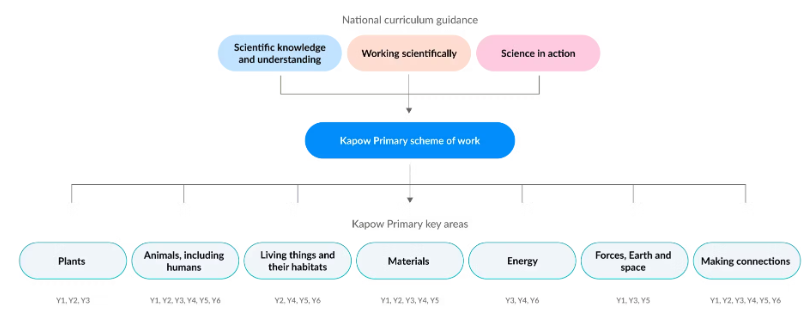
Science is taught using the Kapow scheme of work based on the 2014 National Curriculum with specific units chosen to match the needs of our pupils. The intention is for our pupils to develop the confidence to ask questions, make observations, carry out investigations, record data in a variety of ways and analyse and present their findings.
Based on the National curriculum, the following three strands have been identified, which run throughout the Science curriculum:
- Scientific knowledge and understanding.
- Working scientifically.
- Science in action.
The Science curriculum has been planned with these strands running through each unit, ensuring balanced coverage of the different areas of Science and both substantive and disciplinary knowledge.
Impact
The impact of the Science curriculum will be evident through pupils’ work showing how:
- Maintaining a strong focus on developing substantive scientific knowledge and understanding, including of real-life applications.
- Fostering curiosity and excitement about familiar and unknown observations.
- Challenging misconceptions and demystifying truths.
- Providing clear progression by building on practical and investigative skills across all units.
- Encouraging critical thinking, with the ability to ask perceptive questions and explain and analyse evidence.
- Developing scientific literacy using wide-ranging, specialist vocabulary.
- It has ensured pupils' readiness for their future learning.


